Shopify Malaysia: The Complete Guide to Building an Online Store in Just Hours
Tuesday, June 30, 2026
The rapid advancement of digital technology has transformed the way consumers shop and how businesses reach their customers. In Malaysia, digital transformation—driven by high internet penetration, widespread smartphone usage, and the growing adoption of digital payment solutions—has significantly accelerated the growth of the e-commerce industry. Today, consumers are no longer limited to shopping in physical stores. Instead, they rely on online platforms to compare products, read customer reviews, and complete purchases anytime and from anywhere.
This shift in consumer behaviour has created significant opportunities for businesses of all sizes, from SMEs and startups to established enterprises. Building a strong digital presence is no longer just a competitive advantage—it has become an essential part of a sustainable business growth strategy.
Among the many e-commerce platforms available today, Shopify has emerged as one of the most widely adopted solutions by businesses worldwide. It enables companies to build professional online stores without requiring extensive technical expertise, allowing business owners to focus on product development, marketing, and delivering a better customer experience.
The Growth of E-Commerce in Malaysia
Malaysia is one of Southeast Asia's fastest-growing digital economies, driven by increasing internet accessibility, changing consumer lifestyles, and the widespread adoption of digital payment solutions. These developments have significantly accelerated the growth of the country's e-commerce sector, creating new opportunities for businesses to expand their online presence.
Today, Malaysian consumers purchase far more than everyday essentials online. Products such as electronics, fashion, health and beauty items, home essentials, and even professional services are increasingly being purchased through digital channels. This shift in consumer behaviour has encouraged businesses to diversify their sales channels and engage customers through dedicated e-commerce platforms.
As online shopping continues to grow, competition among businesses has become increasingly intense. Consumers now have greater access to information and are more likely to compare prices, product quality, brand reputation, and customer experience before making a purchase. As a result, establishing a professional digital presence has become a key factor in building customer trust and maintaining a competitive advantage.
Many businesses begin their digital journey by selling through online marketplaces because they offer a fast and accessible way to reach customers. However, as a business grows, relying solely on marketplaces often becomes limiting. A dedicated e-commerce website provides greater control over branding, customer experience, and marketing strategies, while allowing businesses to build a long-term digital asset that supports sustainable growth.
Why Is an E-Commerce Website Important Beyond Online Marketplaces?
Online marketplaces such as Shopee, Lazada, and TikTok Shop provide businesses with access to millions of potential customers, making them an effective channel for generating online sales. However, relying solely on marketplaces as the primary sales channel can create limitations that may affect long-term business growth.
One of the biggest challenges is the limited ability to establish a unique brand identity. Since most marketplace stores follow a similar layout and shopping experience, it can be difficult for businesses to differentiate themselves. In addition, price competition is often more intense, as customers can compare similar products from multiple sellers within seconds.
Another consideration is the dependence on the marketplace's platform and algorithms. Changes to search algorithms, platform policies, or service fees can directly impact product visibility and sales performance. In other words, much of the control remains with the marketplace rather than the business owner.
By contrast, owning a dedicated e-commerce website offers several strategic advantages.
First, it enables businesses to build a stronger and more consistent brand identity through a fully customised design that reflects their unique brand values. Every aspect of the customer journey—from website navigation to the checkout experience—can be tailored to create a seamless and engaging shopping experience.
Second, an e-commerce website gives businesses full ownership of their customer data. Insights such as purchase history, browsing behaviour, and customer databases can be leveraged to support personalised marketing initiatives, including email campaigns, loyalty programmes, and retargeting strategies.
Third, a dedicated website creates opportunities to generate organic traffic through Search Engine Optimization (SEO). Unlike marketplaces, which primarily rely on paid promotions or internal search rankings, a well-optimised website can consistently attract potential customers through Google Search, reducing long-term dependence on paid advertising while building a sustainable source of traffic.
Why Choose Shopify?
Building an e-commerce website from scratch is often perceived as a complex and time-consuming process. It typically involves website development, hosting management, security configuration, ongoing maintenance, and regular system updates. Shopify simplifies this process by providing an all-in-one e-commerce platform designed to help businesses launch and manage their online stores with ease.
With Shopify, businesses can create a professional online store in a relatively short period without requiring advanced programming or web development expertise. The platform includes essential infrastructure such as secure hosting, SSL certificates, automatic software updates, and built-in security, allowing business owners to focus on growing their business rather than managing technical operations.
Beyond its ease of use, Shopify offers a comprehensive ecosystem that supports a wide range of business needs. Through the Shopify App Store, merchants can access thousands of applications for payment gateway integration, inventory management, email marketing, customer support, analytics, and many other business functions. This flexibility enables Shopify to support businesses at every stage of growth, from startups and SMEs to established enterprises.
For businesses operating in Malaysia, Shopify also supports many local business requirements. The platform integrates with popular Malaysian payment gateways, supports multiple currencies, and can be connected with leading local and international shipping providers. These capabilities enable businesses to streamline their operations while delivering a seamless and secure shopping experience for customers.
More than just a website builder, Shopify serves as a long-term digital commerce platform that helps businesses strengthen their brand, enhance credibility, and establish a scalable foundation for sustainable growth.
For businesses seeking long-term success, online marketplaces should be viewed as one of several sales channels rather than the primary digital asset. A dedicated e-commerce website built with Shopify provides greater control over branding, customer relationships, and business growth, enabling companies to create a stronger and more sustainable online presence.
What Is Shopify?
Before building an online store, it is important to understand the platform that will support your business. Choosing the right e-commerce platform impacts not only the website development process but also day-to-day operations, customer experience, and the ability to scale as your business grows.
Shopify is one of the world's leading e-commerce platforms, trusted by businesses of all sizes for its comprehensive features, ease of use, and flexibility. It enables merchants to build professional online stores without the complexity of developing and maintaining a custom website.
Shopify as a Cloud-Based E-Commerce Platform
Shopify is a cloud-based e-commerce platform, also known as Software as a Service (SaaS), that provides all the essential infrastructure required to run an online store. Unlike self-hosted platforms, which require users to manage web hosting, servers, software updates, and security independently, Shopify integrates these services into a single, fully managed solution.
Through a centralized dashboard, business owners can efficiently manage products, orders, inventory, customers, payments, and sales reports from one place. In addition, Shopify offers professionally designed themes and access to thousands of applications that allow businesses to extend functionality based on their specific requirements.
This all-in-one approach makes launching and managing an e-commerce website faster, simpler, and more cost-effective than developing a custom-built solution.
How Does Shopify Work?
Shopify is designed to simplify the process of building and managing an online store, even for users with little or no technical background. After creating an account, merchants can choose a website theme, customise the store's appearance, and add products with details such as descriptions, pricing, product variants, and inventory.
Once the website is published, customers can browse products, place orders, complete secure payments, and finish the checkout process through the Shopify platform. Every transaction is automatically recorded within the dashboard, allowing business owners to monitor orders, manage inventory, and access real-time sales reports.
Because Shopify operates on a secure cloud infrastructure, users do not need to worry about server management, software maintenance, or website security updates. This allows businesses to focus their time and resources on growing their brand, improving customer experience, and increasing sales instead of managing technical infrastructure.
Who Is Shopify Best Suited For?
One of the key reasons Shopify is widely adopted is its ability to support businesses of various sizes and industries. Whether you are launching a new venture or managing an established company, Shopify provides a scalable foundation for building and growing your e-commerce operations.
Shopify is particularly well suited for:
- SMEs looking to build a professional e-commerce website without significant technology investment.
- Startups that require a platform which can be launched quickly and scaled as the business grows.
- Direct-to-Consumer (D2C) brands aiming to strengthen their brand identity while delivering a more personalised shopping experience.
- Businesses seeking to integrate online and offline sales through an omnichannel strategy.
- Companies targeting international markets, with support for multiple currencies, multiple languages, and global logistics integrations.
The flexibility offered by Shopify makes it an ideal solution for a wide range of businesses, from SMEs to larger organisations expanding their digital sales channels. Once you understand how Shopify works and whether it aligns with your business needs, the next step is building an online store that is ready to support your growth. With its intuitive interface and built-in features, Shopify enables businesses to launch a professional e-commerce website quickly—even without prior technical experience.
How to Build an Online Store with Shopify
After understanding what Shopify is and how it supports businesses of different sizes, the next step is building an online store that is ready to serve your customers. One of Shopify's key advantages is its fast implementation process, as the essential infrastructure—including hosting, security, and website management tools—is already provided within a single platform.
Although setting up a Shopify store is relatively straightforward, each stage should be completed carefully. Proper initial configuration helps create a professional website that delivers a seamless customer experience while supporting long-term business growth.
Below are the key steps to building a Shopify store for your business in Malaysia.
Step 1 – Create a Shopify Account
The first step is to create a Shopify account through the official Shopify website. The registration process requires only an email address, a password, and your preferred store name. Once your account has been created, Shopify will generate a dashboard that serves as the central hub for managing your online store.
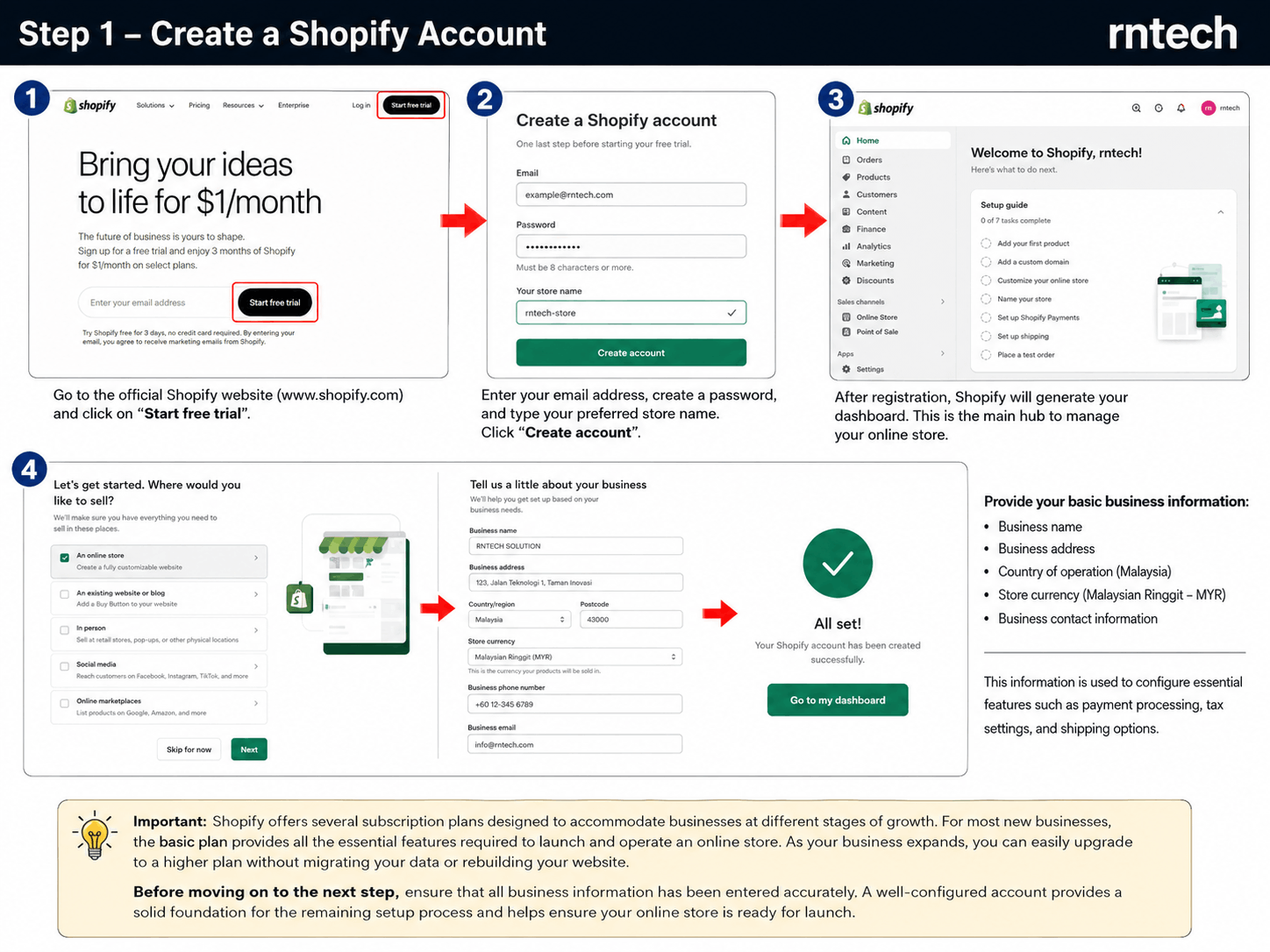
During the initial setup, you will also be asked to provide basic business information, including:
- Business name
- Business address
- Country of operation (Malaysia)
- Store currency (Malaysian Ringgit – MYR)
- Business contact information
This information is used to configure essential features such as payment processing, tax settings, and shipping options.
Shopify offers several subscription plans designed to accommodate businesses at different stages of growth. For most new businesses, the basic plan provides all the essential features required to launch and operate an online store. As your business expands, you can easily upgrade to a higher plan without migrating your data or rebuilding your website.
Before moving on to the next step, ensure that all business information has been entered accurately. A well-configured account provides a solid foundation for the remaining setup process and helps ensure your online store is ready for launch.
Step 2 – Choose the Right Shopify Theme
Once your Shopify account has been created, the next step is selecting a theme for your online store. A Shopify theme influences more than just the visual appearance of your website—it also affects the user experience (UX), website performance, loading speed, and how easily customers can navigate and find your products.
Shopify offers a wide range of both free and premium themes, allowing businesses to choose a design that best matches their industry, brand identity, and functional requirements.
In general, free themes are ideal for businesses that are just getting started, as they provide the essential features needed to operate an online store. Premium themes, on the other hand, offer more advanced design options, additional functionality, and greater flexibility for customisation.
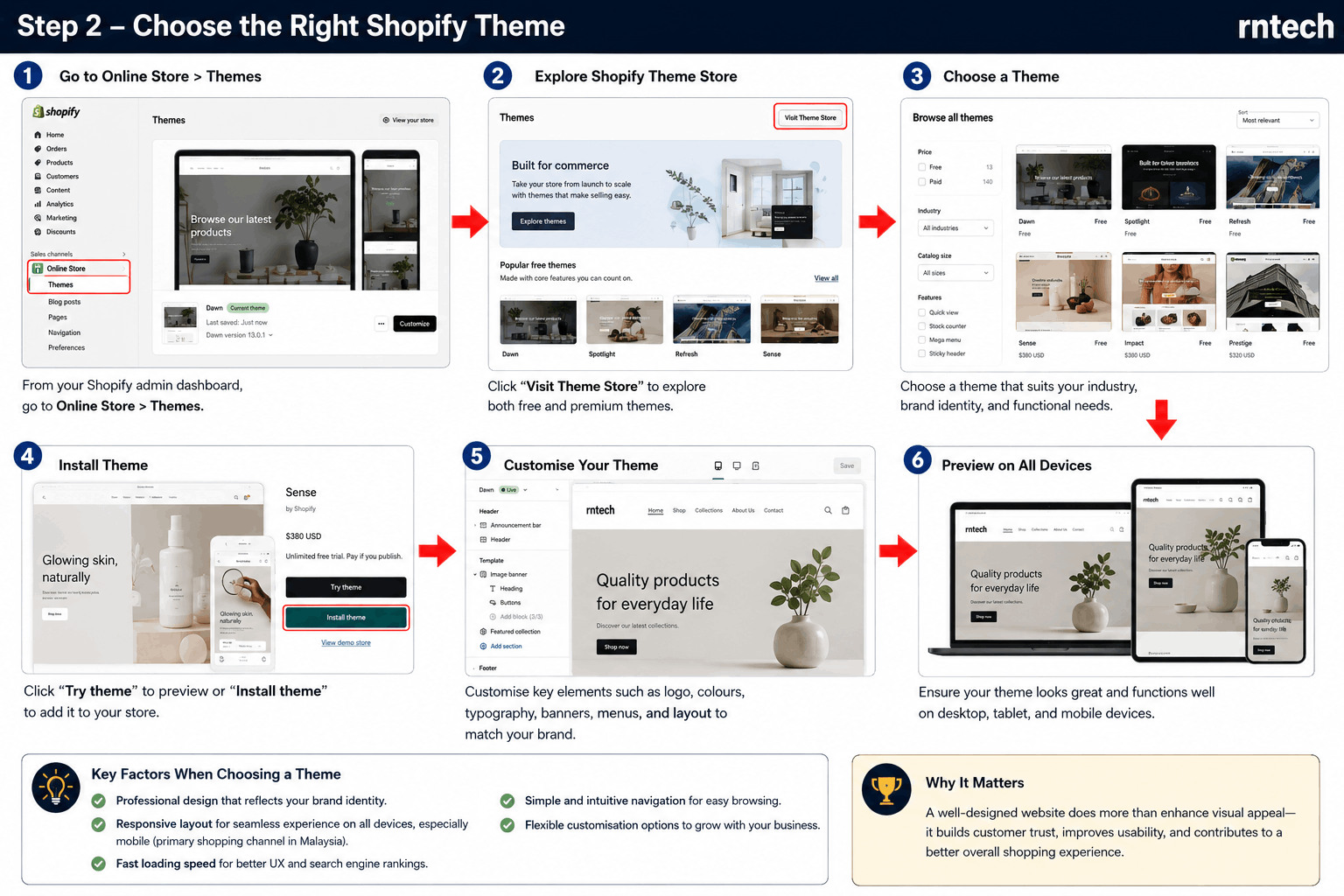
When selecting a Shopify theme, consider the following factors:
- A professional design that reflects your brand identity.
- A responsive layout that delivers a seamless experience across desktops, tablets, and smartphones, particularly as mobile devices are the primary shopping channel for many consumers in Malaysia.
- Fast loading speed, as website performance directly impacts both user experience and search engine rankings.
- Simple and intuitive navigation that enables customers to browse products efficiently.
- Flexible customisation options that allow your website to evolve alongside your business.
After choosing a theme, you can customise key elements such as your company logo, brand colours, typography, homepage banners, navigation menus, and homepage layout to create a consistent and professional brand experience.
A well-designed website does more than enhance visual appeal—it builds customer trust, improves usability, and contributes to a better overall shopping experience.
RN Tech Insight
When selecting a Shopify theme, businesses should look beyond aesthetics alone. Factors such as website performance, application compatibility, SEO-friendly structure, and page speed are equally important. Choosing the right theme from the outset helps deliver an optimal user experience while establishing a strong technical foundation for long-term growth and search engine visibility.
Step 3 – Add Your Products
Products are the foundation of every online store. For this reason, the information displayed on each product page should be complete, accurate, and informative to help customers make confident purchasing decisions.
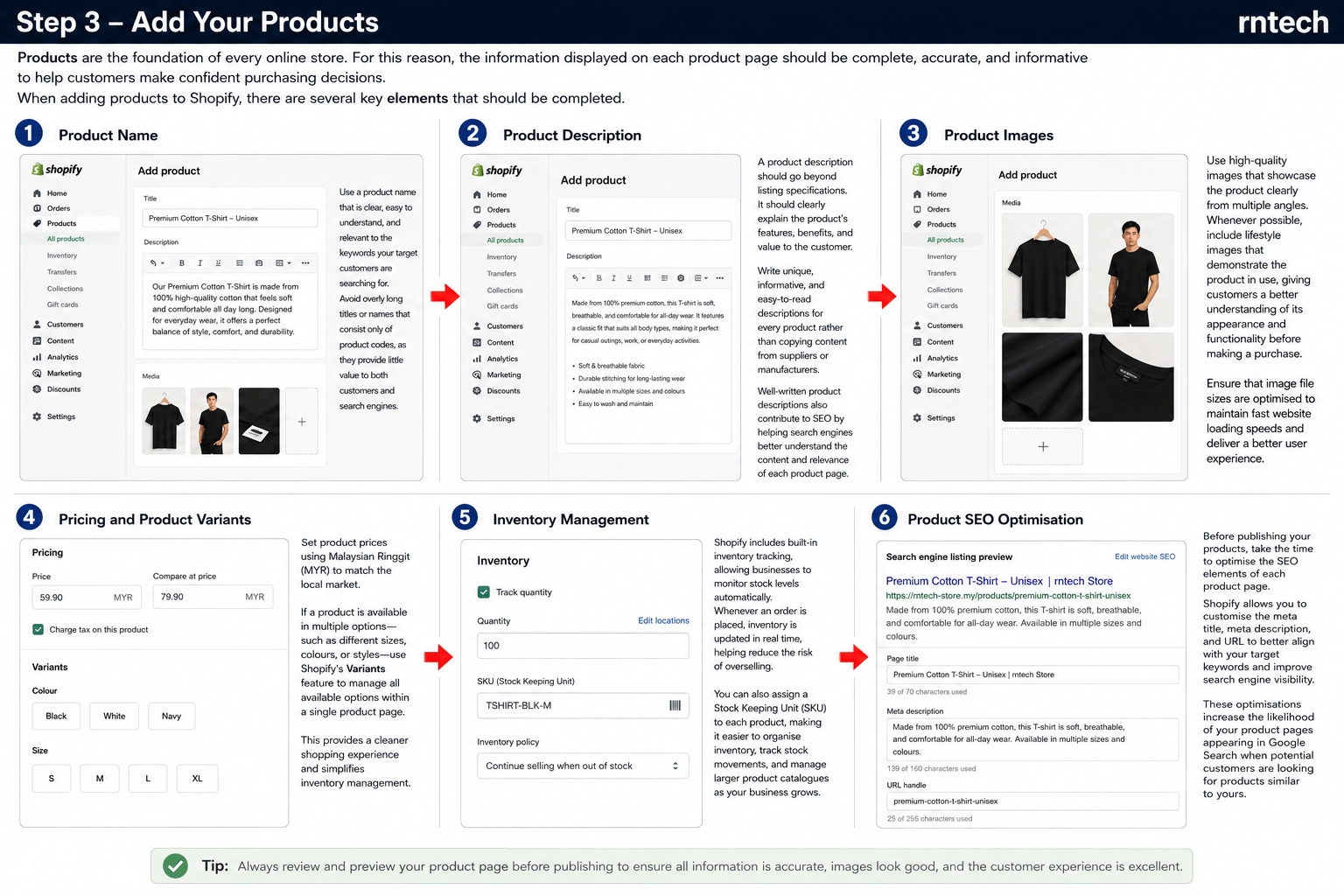
When adding products to Shopify, there are several key elements that should be completed.
Product Name
Use a product name that is clear, easy to understand, and relevant to the keywords your target customers are searching for. Avoid overly long titles or names that consist only of product codes, as they provide little value to both customers and search engines.
Product Description
A product description should go beyond listing specifications. It should clearly explain the product's features, benefits, and value to the customer. Write unique, informative, and easy-to-read descriptions for every product rather than copying content from suppliers or manufacturers.
Well-written product descriptions also contribute to SEO by helping search engines better understand the content and relevance of each product page.
Product Images
Use high-quality images that showcase the product clearly from multiple angles. Whenever possible, include lifestyle images that demonstrate the product in use, giving customers a better understanding of its appearance and functionality before making a purchase.
At the same time, ensure that image file sizes are optimised to maintain fast website loading speeds and deliver a better user experience.
Pricing and Product Variants
Set product prices using Malaysian Ringgit (MYR) to match the local market. If a product is available in multiple options—such as different sizes, colours, or styles—use Shopify's Variants feature to manage all available options within a single product page. This provides a cleaner shopping experience and simplifies inventory management.
Inventory Management
Shopify includes built-in inventory tracking, allowing businesses to monitor stock levels automatically. Whenever an order is placed, inventory is updated in real time, helping reduce the risk of overselling.
You can also assign a Stock Keeping Unit (SKU) to each product, making it easier to organise inventory, track stock movements, and manage larger product catalogues as your business grows.
Product SEO Optimisation
Before publishing your products, take the time to optimise the SEO elements of each product page. Shopify allows you to customise the meta title, meta description, and URL to better align with your target keywords and improve search engine visibility.
These optimisations increase the likelihood of your product pages appearing in Google Search when potential customers are looking for products similar to yours.
RN Tech Insight
Many businesses focus on uploading products as quickly as possible without paying sufficient attention to the quality of their content. However, professional product images, informative descriptions, and a well-optimised SEO structure not only enhance customer trust but also help generate sustainable organic traffic from Google over the long term.
Step 4 – Set Up a Payment Gateway
Once your products have been added, the next step is configuring a payment gateway so customers can complete their purchases securely and conveniently. Shopify supports a wide range of payment gateway providers, allowing businesses to choose the solution that best fits their operational needs in Malaysia.
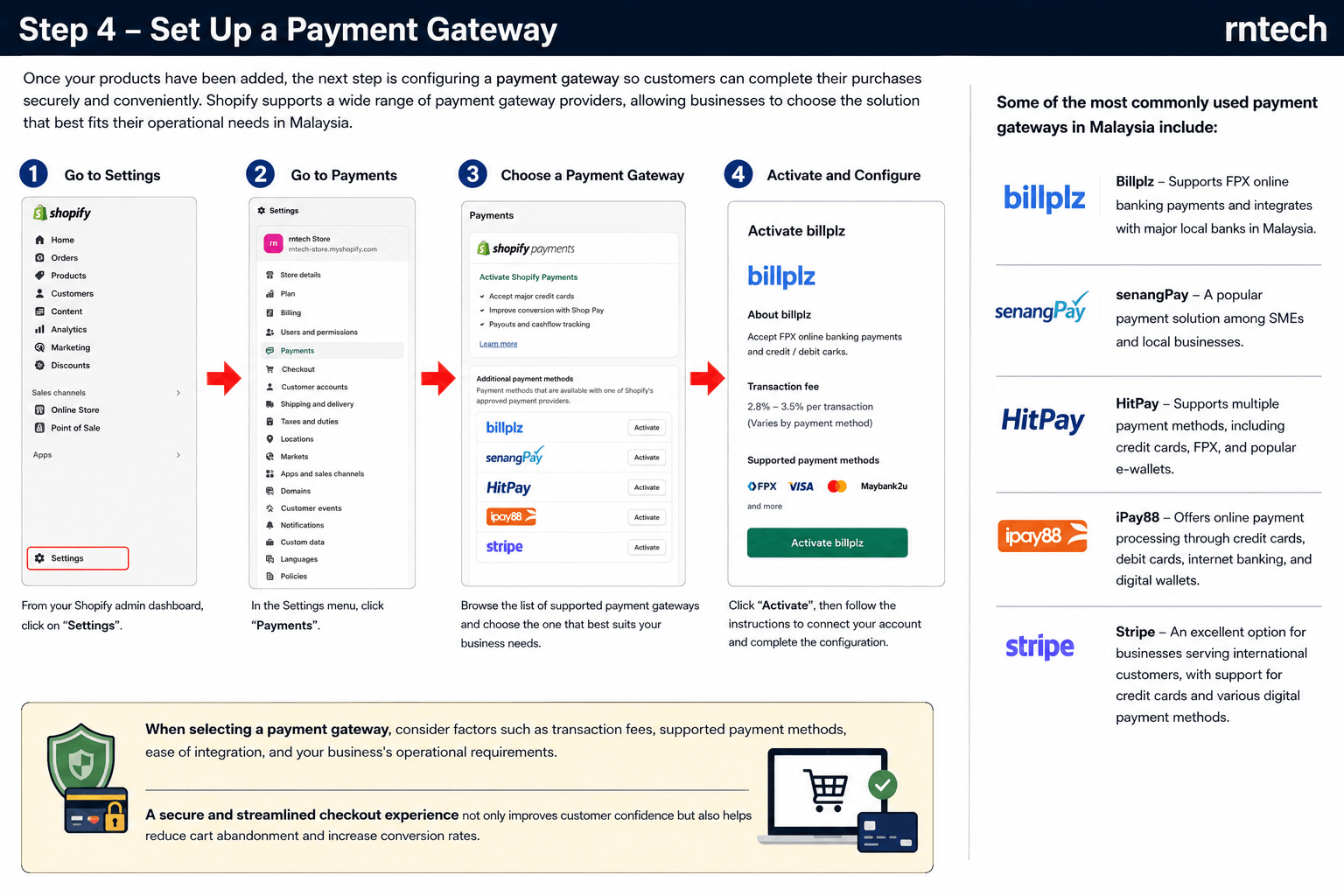
Some of the most commonly used payment gateways in Malaysia include:
- Billplz – Supports FPX online banking payments and integrates with major local banks in Malaysia.
- senangPay – A popular payment solution among SMEs and local businesses.
- HitPay – Supports multiple payment methods, including credit cards, FPX, and popular e-wallets.
- iPay88 – Offers online payment processing through credit cards, debit cards, internet banking, and digital wallets.
- Stripe – An excellent option for businesses serving international customers, with support for credit cards and various digital payment methods.
When selecting a payment gateway, consider factors such as transaction fees, supported payment methods, ease of integration, and your business's operational requirements. A secure and streamlined checkout experience not only improves customer confidence but also helps reduce cart abandonment and increase conversion rates.
RN Tech Insight
RN Tech assists businesses with Shopify payment gateway integration, ensuring that the checkout process is secure, reliable, and tailored to the operational needs of businesses in Malaysia.
Step 5 – Configure Shipping
An effective shipping strategy plays a vital role in delivering a positive customer experience. Shopify enables businesses to configure shipping options based on customer location, product weight, or order value, providing greater flexibility in managing fulfilment.
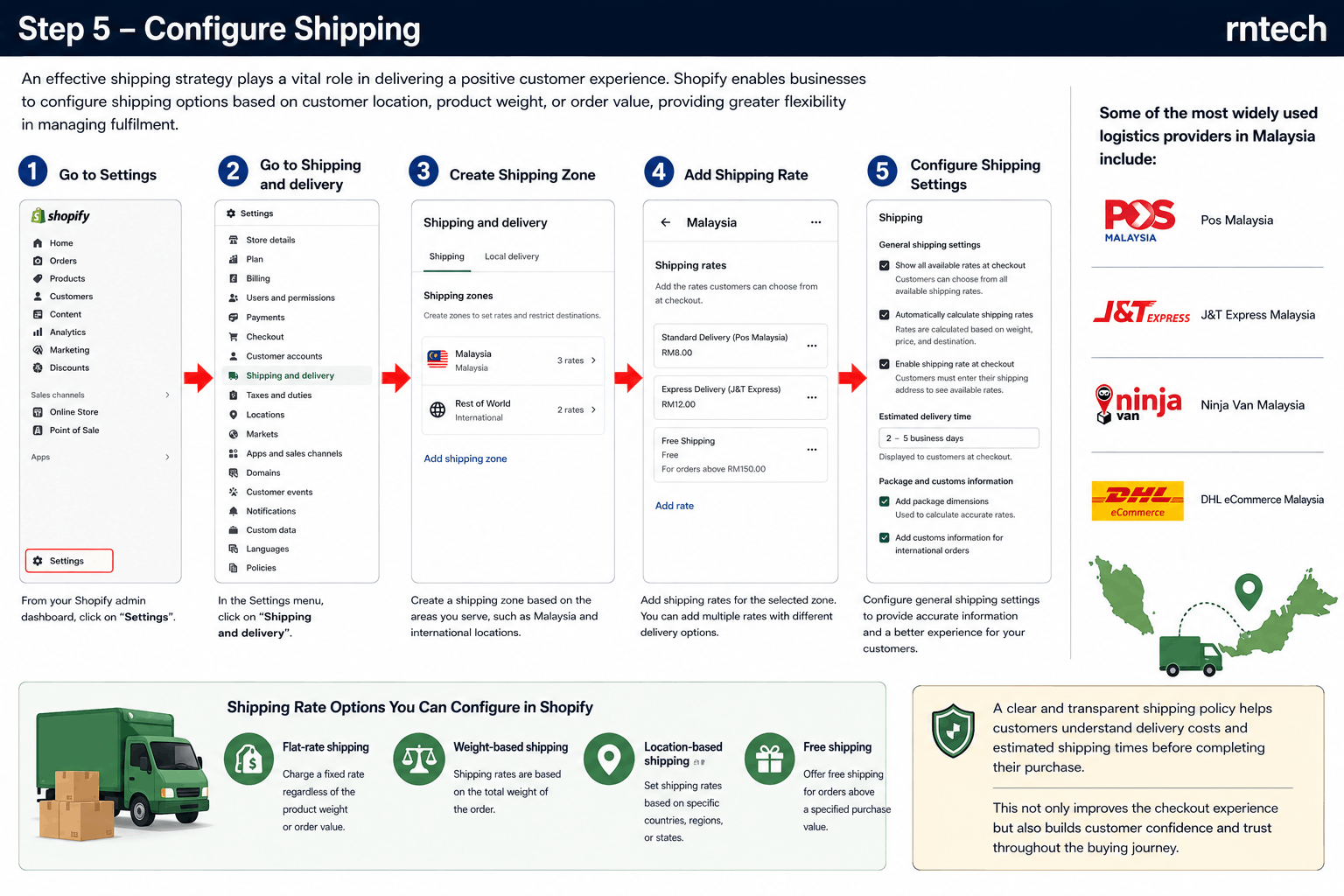
Some of the most widely used logistics providers in Malaysia include:
- Pos Malaysia
- J&T Express Malaysia
- Ninja Van Malaysia
- DHL eCommerce Malaysia
In addition to selecting your preferred shipping providers, Shopify allows you to configure shipping rates based on your business model, including:
- Flat-rate shipping
- Weight-based shipping
- Location-based shipping
- Free shipping for orders above a specified purchase value
A clear and transparent shipping policy helps customers understand delivery costs and estimated shipping times before completing their purchase. This not only improves the checkout experience but also builds customer confidence and trust throughout the buying journey.
Step 6 – Connect a Custom Domain
By default, Shopify provides your store with a myshopify.com subdomain. While this is suitable during the initial setup, businesses are strongly encouraged to use a custom domain to create a more professional and memorable online presence.
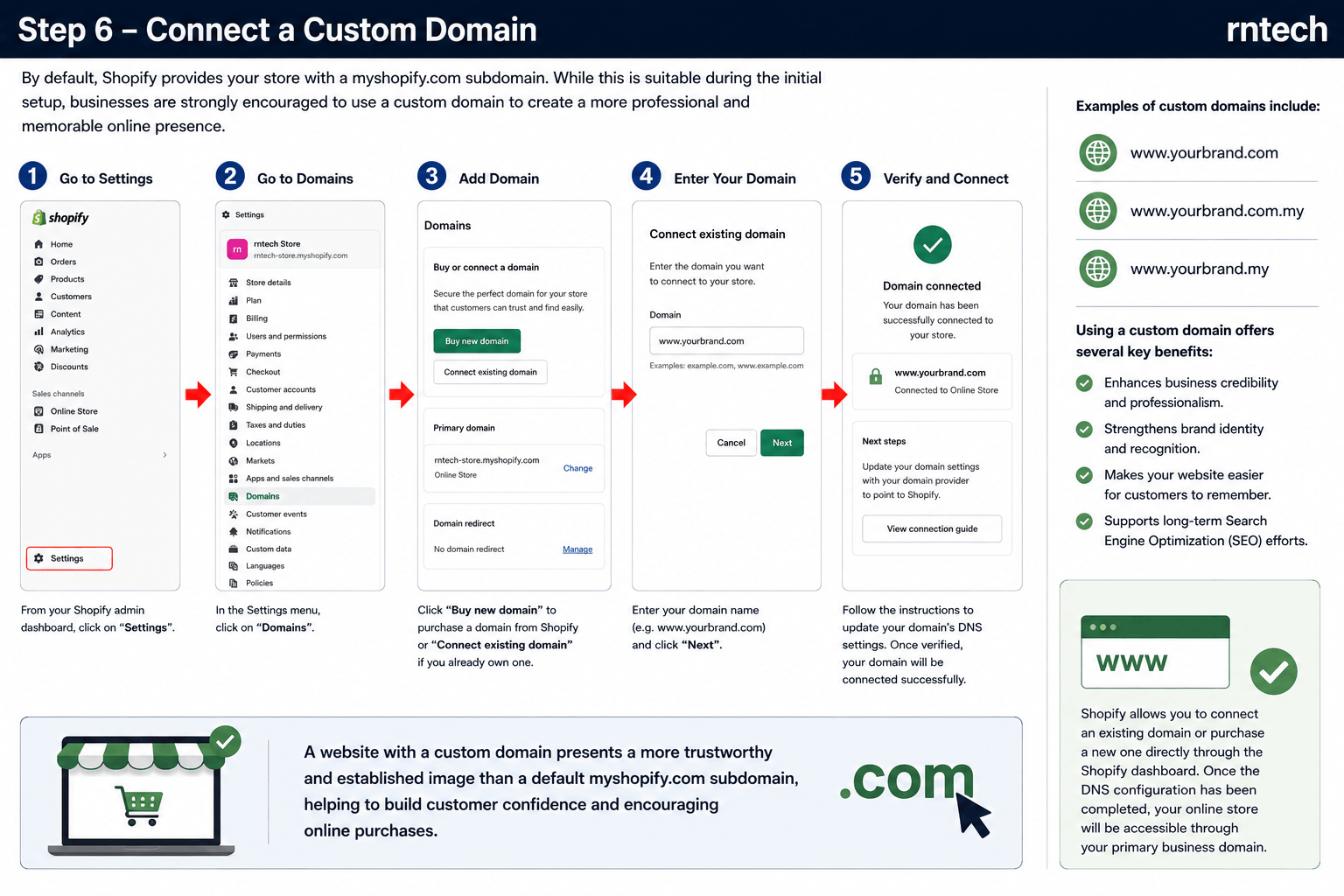
Examples of custom domains include:
Using a custom domain offers several key benefits:
- Enhances business credibility and professionalism.
- Strengthens brand identity and recognition.
- Makes your website easier for customers to remember.
- Supports long-term Search Engine Optimization (SEO) efforts.
Shopify allows you to connect an existing domain or purchase a new one directly through the Shopify dashboard. Once the DNS configuration has been completed, your online store will be accessible through your primary business domain.
A website with a custom domain presents a more trustworthy and established image than a default myshopify.com subdomain, helping to build customer confidence and encouraging online purchases.
Optimising Your Shopify Store to Be Found on Google
Building a Shopify store is the first step toward establishing your digital presence. However, launching a website alone does not guarantee that potential customers will find your business on Google. To improve your online visibility, it is essential to implement an effective Search Engine Optimization (SEO) strategy.
SEO helps search engines understand your website's content and structure, increasing the likelihood of your pages appearing in relevant search results. With the right optimisation strategy, Shopify becomes more than just an e-commerce platform—it becomes a sustainable source of organic traffic that supports long-term business growth.
Why Is SEO Important for a Shopify Website?
A newly launched website does not automatically appear in Google search results. Without proper optimisation, search engines may take longer to discover, index, and rank your pages.
SEO helps search engines understand the relevance of your website, making it easier for potential customers to find your products or services when searching online. Beyond improving visibility, SEO also attracts more qualified traffic, increasing the likelihood of conversions.
For businesses in Malaysia, investing in SEO can also reduce long-term reliance on paid advertising by creating a consistent source of organic traffic from Google.
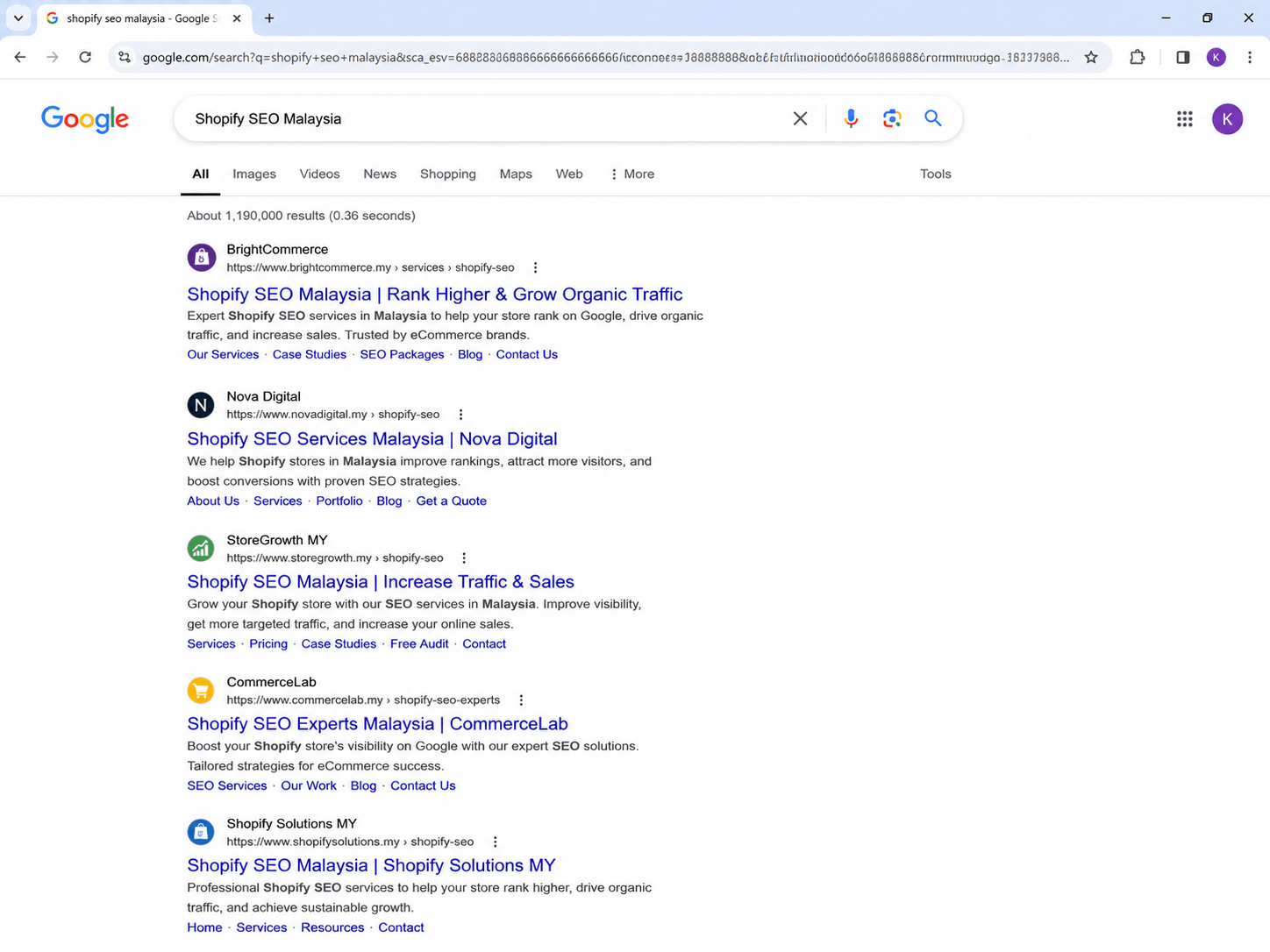
Example of an SEO-optimised Shopify website appearing in Google Search. The example above illustrates how an SEO-optimised Shopify website can rank for relevant keywords in Google Search. By implementing technical SEO, keyword optimisation, and high-quality content, businesses can improve their online visibility, attract more qualified organic traffic, and reduce their reliance on paid advertising over time.
Basic Shopify SEO Optimisation
Shopify includes several built-in features that support search engine optimisation. However, these features should be properly configured to maximise your website's visibility and performance.
Some of the key elements to optimise include:
- Meta titles and meta descriptions to improve click-through rates in search results.
- SEO-friendly URL structures that are concise and relevant to target keywords.
- Heading structure and internal linking to improve website organisation and search engine crawlability.
- Image optimisation to maintain fast loading speeds without compromising quality.
- Website speed and mobile responsiveness to deliver a better user experience across all devices.
Together, these optimisations help improve website performance while supporting stronger rankings in Google Search.
The Role of Content in Driving Organic Traffic
Content plays a vital role in attracting visitors through organic search. By leveraging Shopify's built-in blogging functionality, businesses can publish informative content that answers customer questions, provides valuable insights, and builds trust with their audience.
Articles that address users' search intent not only increase website traffic but also guide visitors toward relevant product pages. Over time, a consistent content strategy helps strengthen your website's authority and improve its visibility in search engine results.
How RN Tech Helps Optimise Shopify Stores
Optimising a Shopify store is an ongoing process that requires both technical expertise and strategic planning. RN Tech helps businesses improve their Shopify website performance through services including keyword research, technical SEO, on-page optimisation, and content development.
Our approach focuses on increasing search visibility while attracting more relevant organic traffic. With the right optimisation strategy, a Shopify store can become a valuable digital asset that supports sustainable business growth over the long term.
Common Mistakes Shopify Store Owners Make
Building an online store with Shopify is relatively straightforward, but many businesses fail to maximise the platform's full potential. The following are some of the most common mistakes that can negatively impact user experience, website performance, and overall sales.
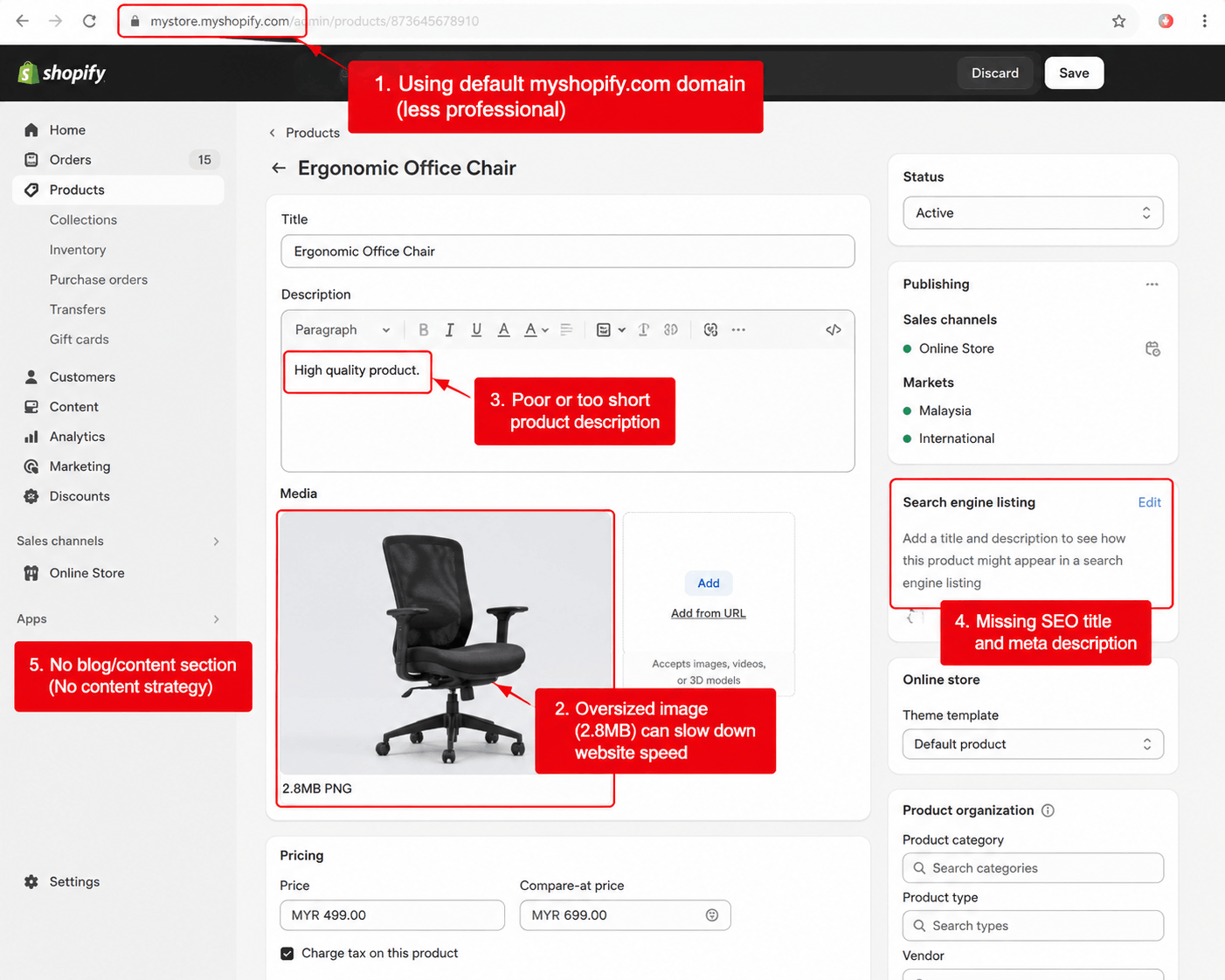
Common Shopify mistakes that can negatively affect website performance, search visibility, and customer experience. The example above highlights several issues frequently found on newly launched Shopify stores, including the use of a default subdomain, oversized images, weak product descriptions, missing SEO elements, and the absence of a content strategy.
Not Using a Custom Domain
Some businesses continue using the default myshopify.com subdomain even after launching their online store. Using a custom domain such as .com or .com.my enhances business credibility, strengthens brand identity, and presents a more professional image to customers.
Uploading Oversized Images
High-quality product images are essential, but large image files can significantly slow down website loading times. To maintain optimal website performance, images should be properly compressed without compromising visual quality.
Writing Poor or Generic Product Descriptions
Many store owners simply list product specifications or copy descriptions provided by suppliers. However, unique, informative, and benefit-focused product descriptions help build customer trust while also improving SEO performance by providing valuable content for search engines.
Neglecting Content and SEO
A website that consists only of product pages has fewer opportunities to attract organic traffic. Publishing informative blog articles, optimising product pages, and implementing fundamental SEO best practices can help improve your website's visibility on Google and attract potential customers.
Relying Solely on Paid Advertising
Paid advertising can generate immediate results, but it should not be the only growth strategy. Combining Shopify with a well-planned SEO and content marketing strategy helps build a sustainable source of organic traffic, reducing long-term dependence on advertising budgets while supporting continuous business growth.
How RN Tech Helps Your Business
Building a Shopify store is the first step toward growing a successful digital business. However, creating a professional, user-friendly website that consistently generates sales requires careful planning, technical expertise, and ongoing optimisation.
RN Tech helps businesses in Malaysia build and optimise Shopify stores that align with their operational requirements and long-term business goals. From website development and platform migration to payment gateway integration and performance optimisation, every solution is designed to create a scalable e-commerce website that supports sustainable business growth.
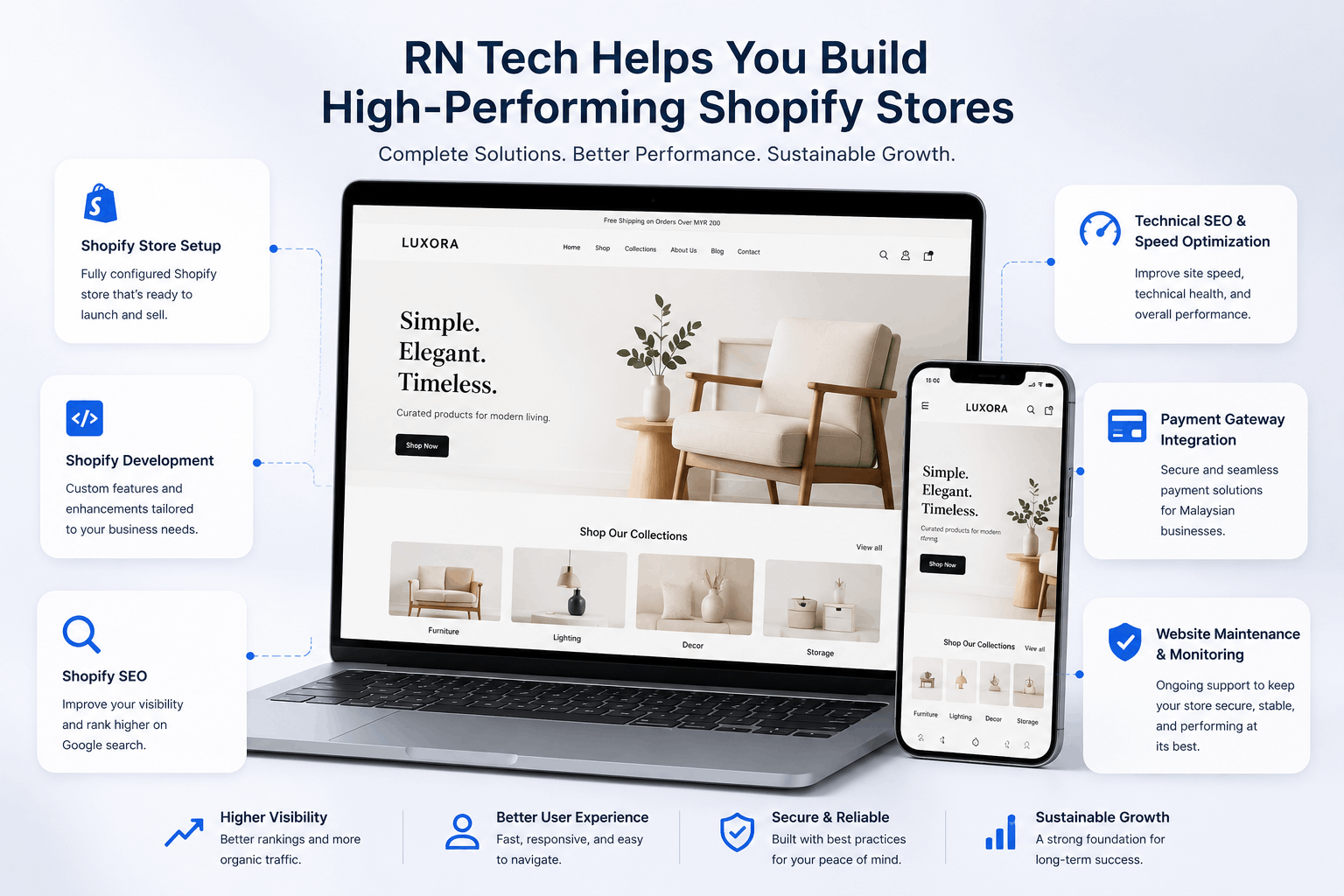
Complete Shopify solutions designed to support sustainable business growth. RN Tech helps businesses build, optimise, and maintain high-performing Shopify stores through professional development, SEO, payment gateway integration, and ongoing technical support.
Our Shopify services include:
- Shopify Store Setup – Launch a fully configured online store that is ready for business.
- Shopify Development – Custom feature development and store enhancements tailored to your business requirements.
- Shopify Migration – Seamless migration from platforms such as WooCommerce or Magento to Shopify.
- Shopify SEO – Improve your website's visibility and organic rankings on Google.
- Technical SEO & Speed Optimisation – Enhance website performance, loading speed, and technical SEO health.
- Payment Gateway Integration – Integrate secure payment solutions that support businesses operating in Malaysia.
- Website Maintenance & Performance Monitoring – Ensure your Shopify store remains secure, stable, and performs at its best.
By focusing on website performance, user experience, and digital growth strategies, RN Tech helps businesses build Shopify websites that are not only visually appealing but also optimised to support long-term business success.
Conclusion
Shopify is one of the leading e-commerce platforms for businesses looking to launch an online store quickly, securely, and with minimal technical complexity. Its comprehensive features provide businesses of all sizes with the flexibility to deliver a professional online shopping experience while supporting future growth.
However, a successful e-commerce website requires more than an attractive design. Factors such as website structure, user experience, payment integration, SEO strategy, and content management all play a critical role in improving online visibility and driving sustainable business growth.
Whether you are planning to launch a new Shopify store, migrate from another e-commerce platform, or optimise an existing website, RN Tech provides tailored Shopify solutions designed to meet your business objectives.
Contact RN Tech to discuss your project requirements and discover how Shopify can become the foundation of your long-term digital growth strategy.